Why Are Other Countries Concerned About Modi, and Why Does Rahul Gandhi Get International Support? What Do the Facts Say?
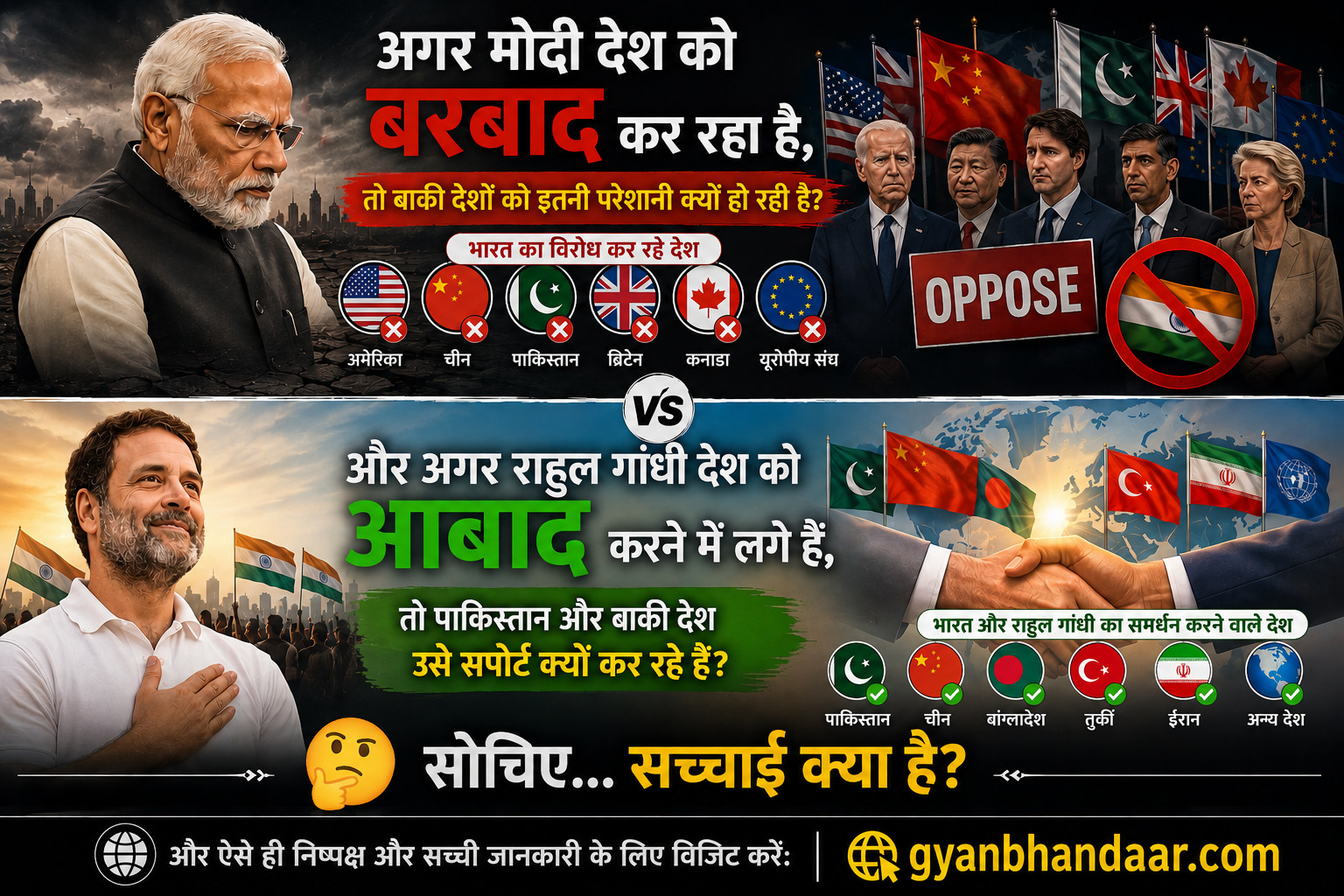
A question frequently raised in Indian political discussions is:
If Narendra Modi is allegedly “ruining” India, why are other countries so concerned about his policies? And if Rahul Gandhi claims to be working toward a better India, why do some foreign countries and international groups appear more receptive to his views?
The answer, however, is more complicated than simply deciding which countries are “with” Modi and which are “with” Rahul Gandhi.
International politics is primarily driven by national interests, trade, security, energy, geopolitics and strategic partnerships.
Is the World Really Against Modi?
It would not be factually accurate to say that the world is simply against Narendra Modi or India under his government.
India has developed strong strategic relationships with countries such as the United States, France, Japan, Australia and several European nations.
At the same time, India has also experienced significant disagreements with some of these countries over issues such as trade, tariffs, Russia, energy imports and human rights.
The relationship between India and the United States is a good example.
The two countries cooperate closely on defence, technology, the Indo-Pacific and strategic security. However, there have also been serious disagreements over trade and India’s purchase of Russian oil.
In 2025, the United States imposed additional tariffs on Indian goods, with the Trump administration linking part of the action to India’s continued purchase of Russian oil.
Does that automatically mean the United States is “against Modi”?
No.
It demonstrates something much more important:
Countries can cooperate with each other while simultaneously disagreeing on specific policies.
That is how international diplomacy works.
Why Do Other Countries Put Pressure on India?
India is no longer a country whose decisions can be ignored internationally.
India is one of the world’s largest economies, has a population of more than 1.4 billion people, occupies a strategically important geographical position and is becoming increasingly important in global supply chains, defence, technology and energy.
According to World Bank data, India’s GDP was approximately $3.96 trillion in 2025, while real GDP growth was around 7.6%.
When a country of India’s size changes its trade, energy, defence or foreign-policy decisions, other countries naturally pay attention.
The United States has its own interests.
China has its own interests.
Russia has its own interests.
European countries have their own interests.
Pakistan has its own interests.
Therefore, disagreement with one Indian policy should not automatically be interpreted as opposition to India itself.
Why Does Rahul Gandhi Get International Attention?
Rahul Gandhi is one of India’s most prominent opposition leaders and is the Leader of the Opposition in the Lok Sabha.
He has repeatedly raised questions about India’s democratic institutions, freedom of the press, social issues and the functioning of government.
During his international visits, he has spoken at foreign universities, political forums and media organisations.
For example, during his 2023 visit to the United States, Rahul Gandhi spoke about democracy, institutional independence and press freedom in India.
But there is an important distinction here.
Being given a platform abroad does not necessarily mean receiving official support from a foreign government.
Foreign politicians, journalists, academics and organisations can agree with certain statements made by an Indian opposition leader without supporting that person’s political ambitions.
The same principle applies to Narendra Modi.
A foreign government praising one of Modi’s policies does not automatically mean that the government supports every decision made by his administration.
Does Pakistan Support Rahul Gandhi?
This claim requires particular caution.
India-Pakistan relations remain extremely complicated because of terrorism, Kashmir, military tensions and decades of political conflict.
Pakistan’s political and media establishment has, at times, highlighted statements made by Indian opposition leaders when those statements support Pakistan’s preferred narrative.
However, this does not automatically prove that the Pakistani government officially supports Rahul Gandhi as India’s future Prime Minister.
That would be a much stronger claim and would require direct and credible evidence.
This distinction is important because political narratives can easily turn a foreign media statement into an allegation of official government support.
What About the Countries That Criticise Modi?
There are certainly international organisations and foreign governments that have criticised various aspects of India’s policies.
Issues such as:
- Freedom of the press
- Human rights
- Treatment of minorities
- Democratic institutions
- Civil liberties
- Trade policies
- India’s relationship with Russia
have attracted international attention.
For example, Reporters Without Borders ranked India 157th out of 180 countries in its 2026 World Press Freedom Index.
This does not by itself prove that democracy has ended in India.
However, it does demonstrate that concerns about press freedom exist internationally and should not simply be dismissed.
At the same time, supporters of the Modi government point to India’s economic growth, infrastructure development, digital public infrastructure, defence capabilities and expanding global partnerships.
Both sides of the political debate therefore have arguments that deserve examination.
What Evidence Supports the Modi Government?
Supporters of Narendra Modi point to several developments.
India has experienced strong economic growth in recent years.
According to the World Bank, India’s real GDP growth was approximately 7.6% in 2025.
India has also expanded its strategic partnerships with the United States, Europe, Japan, Australia and countries in the Middle East.
The government has highlighted infrastructure development, digital payments, manufacturing initiatives, defence production and India’s increasing role in global diplomacy as major achievements.
India’s ability to maintain relationships with countries that themselves have conflicting interests is also significant.
For example, India has maintained strategic cooperation with the United States while continuing its longstanding relationship with Russia.
This reflects India’s attempt to pursue an independent foreign policy based on its own national interests.
But There Are Also Valid Criticisms
Criticism of the government should not automatically be treated as being anti-India.
Opposition parties and independent organisations have raised concerns about employment, inflation, institutional independence, press freedom, social tensions and government accountability.
These issues deserve to be examined through data rather than political slogans.
Similarly, criticism of Rahul Gandhi should also be based on his policies, statements, political record and proposed solutions rather than simply on which foreign media outlet has covered him.
The Real Question Is Not “Who Does the World Support?”
This is perhaps the most important point.
A country’s foreign policy should not determine how Indian citizens evaluate an Indian politician.
Suppose America criticises a particular Indian policy.
That does not automatically make the Indian policy wrong.
Suppose Pakistan praises a statement made by an Indian opposition leader.
That does not automatically make the opposition leader anti-India.
Suppose China disagrees with India’s foreign policy.
That does not automatically make India’s policy correct.
International reactions are evidence that should be examined, not automatic proof of political truth.
The better questions are:
- Is India’s economy growing?
- Are ordinary citizens seeing improvements in their income and living standards?
- Are enough quality jobs being created?
- Is India’s national security improving?
- Is India’s global influence increasing?
- Are democratic institutions functioning effectively?
- Is freedom of the press adequately protected?
- Are government policies producing measurable results?
- What are the long-term consequences of these policies?
These questions are far more important than simply asking which foreign country supports which Indian politician.
Modi vs Rahul Gandhi: What Should Voters Actually Examine?
The political debate should ultimately focus on performance, policies and evidence.
For Narendra Modi, voters can examine his government’s economic record, infrastructure development, foreign policy, national security policies, employment record and institutional governance.
For Rahul Gandhi and the Congress, voters can examine their proposed economic policies, employment strategy, welfare programmes, institutional reforms, national-security approach and political record.
Foreign praise or criticism can provide context.
But it should never replace independent evaluation.
Conclusion
The idea that “the world is against Modi” or “foreign countries support Rahul Gandhi” is too simplistic to explain international politics.
India has strong relationships with many countries while simultaneously having disagreements with them.
The United States can cooperate with India on defence while disagreeing with India over trade or Russian oil.
European countries can negotiate major trade agreements with India while raising concerns about human rights or democratic issues.
Foreign politicians and organisations can appreciate Rahul Gandhi’s views without officially supporting him as India’s future leader.
And Pakistan using statements from Indian opposition politicians for its own political narrative does not automatically establish an official Pakistani endorsement of Rahul Gandhi.
The bigger lesson is this:
A foreign country’s reaction to an Indian politician is not the final test of whether that politician is good or bad for India.
The real test should be India’s economic performance, national security, employment, democratic institutions, social stability, global standing and the quality of policies being proposed.
So perhaps the most important question is not:
“Which foreign country supports Modi or Rahul Gandhi?”
It is:
“Who is actually better for India, and what does the evidence show?”
In a democracy, the final decision does not belong to America, Pakistan, China, Europe or any other foreign power.
It belongs to the people of India.
For more fact-based articles and political analysis, visit: